
Boxing Day 2026
26. Dezember 2026
Kursaal Arena Bern
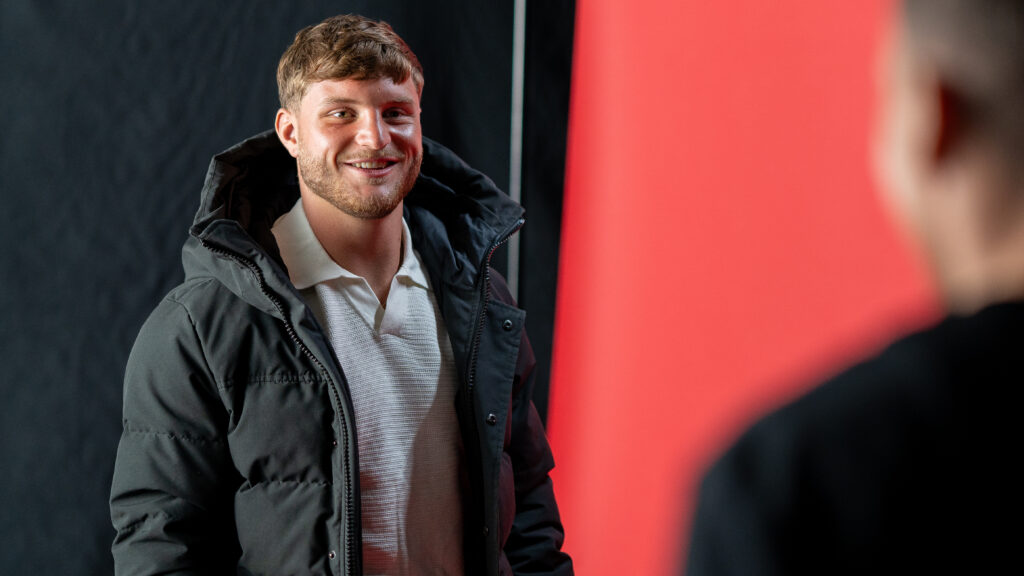
Félix Meier won his tenth professional fight last Saturday in Bellach and remains undefeated. This week, the 21-year-old from Lausanne leads the pound-for-pound ranking of active Swiss professional boxers. On December 26th, he will fight against Alfred Kqira in the Kursaal Arena Bern for the Swiss Super Welterweight Championship. It is Meier's first title fight.
Endurance test in Bellach
On September 12th in Bellach, professional boxer Luis Enrique Romero didn't step into the ring to lose, but to test the young Félix Meier. The Venezuelan is a journeyman with a negative fight record of 13 16 1. A closer look reveals his few early defeats (3) as well as victories in Italy and Spain. Against Meier, Romero conceded after three rounds. Meier recognized the signs early in the fight: "He tried to buy time with little tricks. Clenching, delaying the round break, shoelaces. It surprised me that he gave up completely." This was Meier's tenth fight in his just 22-month-old professional boxing career, his seventh early victory. He has now fought 44 rounds as a professional.
A nice record
People are quick to judge a 10-0 record in boxing—and they’re usually wrong, in both directions. Professional boxing doesn’t work like a league. Fights are selected on a case-by-case basis; that’s no secret—that’s just how the sport works. The question, though, is: with what goal in mind? “I don’t primarily choose the opponents; I choose the fights. It’s about staying active and gaining experience—sometimes against a young, undefeated fighter, sometimes against a seasoned veteran. What’s important is that the level of competition rises, and with it, the challenge. And there’s always some risk involved if you want to move forward,” explains Meier’s manager and promoter, Leander Strupler. In response to critics’ objections that ten wins don’t prove anything, he replies—in a way you rarely hear from a promoter: “They’re right. Many boxers today have inflated 0-0 records that mean absolutely nothing. But what others do is irrelevant to us. I know that Félix has defeated opponents whom other Swiss boxers wouldn’t stand a chance against. We’re going our own way, and it’s still a long and rocky road. We haven’t achieved anything yet.”
At the Top of the Rankings
The professional boxing encyclopedia BoxRec is regarded as the leading independent statistics platform in the world of boxing. When filtering the rankings of active professional boxers from Switzerland across all weight classes (pound-for-pound), Félix Meier appears in first place. He ranks ahead of Ramadan Hiseni (22-3-2), Angel Roque (11-0-1), and Faton Vukshinaj (17-3-2), all of whom are at least 30 years old and have fought significantly more bouts. This ranking is a calculation, not a judgment, and is based on a proprietary algorithm that compiles a ranking from fight results. But it is the ranking of a platform that has no interest in misrepresenting the boxing world, and it favors a 21-year-old.
Becoming a Swiss Champion with YouTube Videos
Meier was born in Lausanne, where he boxed as a teenager at the “Fight District” boxing club. His amateur boxing record from that time: 30 wins, 11 losses. He won seven Swiss championship titles, ranging from the cadet division in 2018 through the junior and youth divisions to the elite title in November 2022. He won a large portion of these titles without any systematic coaching. For long stretches, he trained on his own, at home or at the gym, and taught himself how to box, often with the help of YouTube videos. “I watched a lot of fights online and then tried to put what I’d observed into practice during sparring. I also watched instructional videos that described punches, combinations, or movements. Many of them were in Russian. I didn’t understand what was being said, but I just copied the movements.” He was inspired by the Ukrainian Olympic and world champion Vasyl Lomachenko. “Because he moves so well. I tried to imitate him. Physically, we’re different—I’m heavier. But I picked up a few things from him.”
Christina Nigg, the pioneer of Swiss women’s boxing and then-head of competitive sports at the Swiss Boxing Federation, had brought the young boxer to the attention of Meier’s current manager early on. “Christina raved about his instincts and boxing skills, but also about what matters outside the ring: his character and his stable environment. She was also the first to introduce professional coaching to Felix. ” recalls Strupler.
A sports policy decision was the deciding factor in Meier’s early move to the professional ranks. For the 2024 Olympic Games, the number of weight classes was reduced. Meier’s super welterweight class (up to 69 kg) was eliminated, and the class below it was out of his reach. So Meier turned pro in November 2024. Strupler signed him to a five-year contract—an unusually long term for a Swiss boxer at the start of his career—and brought him to Bern to join the Boxing Kings, where he is trained by Alain Chervet. Since then, Meier has been the only Swiss boxer to compete as a full-time professional. He trains daily in Bern—working on his boxing with Chervet and on his athletic conditioning with Fabian Seiler at the “Rope” fitness studio.
Full of Technique and Pressure
Anyone who thinks Meier is just a long-range boxer hasn’t seen him in action. His coach describes him this way: “Félix boxes compactly, has a very good sense of distance, and can anticipate his opponent’s moves. He’s a fast-paced boxer who works his way forward with a lot of pressure and keeps his opponent constantly on the defensive.” When asked about his biggest weakness, Chervet doesn’t cite a technical one. “Félix sometimes tries to do too much in training and then has to be reined in. He’s very ambitious, eager to learn, and wants to keep improving. The team’s job is to channel that energy properly and make sure he uses it at the right moment.”
What makes Meier special is evident outside the ring: a polite, reserved young man who doesn’t make a big deal of himself. “I’m one of the quiet types, but there’s a lot going on inside. Boxing is a way for me to let off some steam.” Meier doesn’t see a switch that transforms this nice young man into a boxer with a killer instinct. “I don’t have a ritual or a phrase I tell myself. I think it’s subconscious. It just happens on its own. I learned early on that being polite doesn’t get me anywhere in the ring. When I step into the ring, being nice is over. Then the person standing in front of me gets everything I’ve got.”
Title Fight at Year’s End
Before the title fight on St. Stephen’s Day, another warm-up bout is scheduled for October 23 in Puidoux. “The event takes place near Lausanne, and it’s important for Félix to show himself to the fans in western Switzerland as well. He’s particularly popular there, and the timing works out well, too.” After that, there will be a good two months to prepare for “Boxing Day.”
On December 26, Alfred Kqira awaits. The Zurich native, born in Kosovo, will be 31 on fight day—nine years older than Meier. 170 centimeters versus 178. “Young dream son-in-law versus seasoned bad boy”—that’s how the promoter describes this high-contrast showdown. “El Chapo”—a drug cartel boss made famous by Netflix—is Kqira’s nickname because he’s small for his weight class but particularly ruthless. And Kqira boxes exactly as someone with his physical attributes must: aggressively and with risk, in close quarters where reach is meaningless. Kqira’s 9-3 record speaks for itself. In April 2023, he knocked out Dutch champion Steve Suppan (13-1-1) in the first round at the Bern City Theater. Eight months later, on Boxing Day, he faced the undefeated Polish fighter Lukas Dekys and lost by decision over eight rounds. In December 2024, he faced the also undefeated Yauheni Makarchuk at Zurich’s Hallenstadion and lost. Two of his three losses came against fighters with spotless records. Kqira hasn’t boxed since then. He runs two of his own boxing gyms and now only participates in select kickboxing and boxing matches. He’s no longer interested in stepping-stone opponents. On December 26, he plans to relaunch his boxing career with a victory. “Alfred is a risk for any opponent. He can take a lot of punishment, come in aggressively, and knock anyone out,” warns Strupler.
The fact that such a matchup came together is by no means a given in Swiss boxing. An undefeated 22-year-old with seven early-round victories is not an easy opponent for anyone. Everyone in the weight class was approached. Kqira agreed to the fight. “Unfortunately, Swiss matchups rarely happen. I’ve reached out to many fighters, but for a long time without success. In the end, you need someone willing to take the risk. Alfred agreed to the fight, and I give him a lot of credit for that.”
The premise of the fight can be summarized as follows: Kqira is looking for that one hard punch—the one that decides everything. Meier works with combinations and tries to increase the pressure over the rounds to wear down his opponent. Chervet gives his protégé the following advice: “Félix must stay focused from the first to the last second. A solid guard, clean footwork, and above all: don’t just stand there in front of your opponent.”
The Time-Honored Tradition of December 26
Boxing matches have been held in Switzerland on St. Stephen’s Day for decades. In 1969, Fritz Chervet stepped into the ring on this date; in 1971, Muhammad Ali knocked out Jürgen Blin of Hamburg in the seventh round at Zurich’s Hallenstadion. Promoter Charly Bühler brought the event to Bern, Daniel Hartmann popularized the name “Boxing Day,” and since 2017, Leander Strupler has been organizing the event through his company “Swiss Pro Boxing.” “Where I train, I see all the posters from past Boxing Days and feel how much tradition is behind it. To be the main event there is an honor, and since it’s the last fight of the calendar year, it’s the highlight,” says Meier. In terms of his preparation, however, the fight is just like any other: “I always prepare just as thoroughly so that the feeling I have when I step into the ring doesn’t change. I’ve seen with other boxers that mishaps happen when you’re under too much pressure or take things too lightly. In boxing, things happen fast—one punch can change everything. I focus on the fight, not on everything else.”